Total Pageviews

Sunday, February 26, 2017

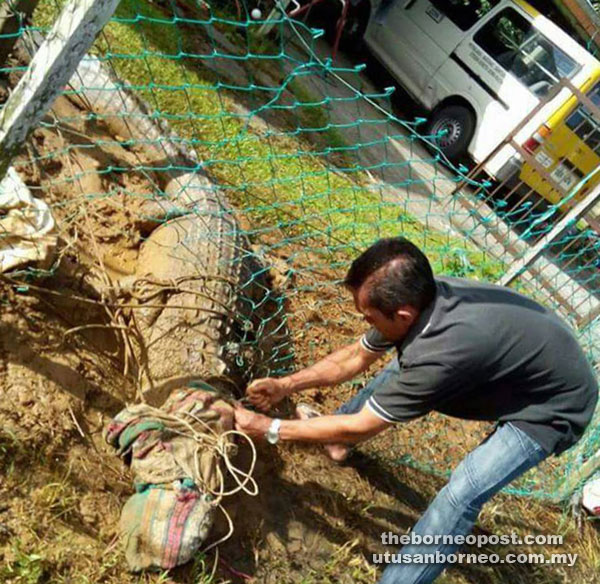
(March 2015) Nelayan terkejut bangkai buaya dalam jaring - Fishermen stunned to find a dead crocodile in his net. Kampung Bako, Kuching.

# News Source
(The Star)
Published : March 13, 2015
Sarawak Forestry Corporation wildlife officer Wan Mazlan Wan Majian inspecting the crocodile carcass at Kampung Bako in Kuching. 

KUCHING 12 Mac 2015 – Enam sahabat berasa cukup teruja apabila mendapati jaring yang dipasang berhampiran Teluk Langkang, Bako di sini hari ini terasa berat apabila ditarik kerana menyangka ada ikan besar tersangkut di dalamnya.

Namun, alangkah terkejutnya mereka apabila melihat seekor buaya tembaga seberat 200 kilogram dan 3 meter panjang yang sudah mati melekat pada jaring berkenaan.

Hamka Anuar, 35, berkata, dia bersama rakan-rakan memang sudah biasa menjaring ikan di kawasan tersebut sejak setahun lalu tetapi ini pertama kali buaya terperangkap dalam jaring yang dipasang.

Pekerja perahu penambang itu memberitahu, mereka menaiki sebuah perahu dari jeti Taman Negara Bako untuk memeriksa jaring yang dipasang kira-kira lima kilometer (km) dari situ pada pukul 10 pagi.

“Apabila sampai, kami terus menarik jaring untuk menaikkan ikan tetapi kali ini berasa hairan kerana berat yang luar biasa.

“Kami berasa teruja kerana menyangka ikan besar yang tersangkut lalu menggunakan segala kudrat yang ada untuk menarik jaring.

“Namun, kami semua terkejut besar sebaik sahaja melihat muncung mulut buaya timbul selepas jaring berjaya dinaikkan,” katanya kepada pemberita di Jeti Taman Negara Bako.

Hamka berkata, mereka berasa lega apabila mendapati buaya terbabit sudah mati dan mengambil keputusan menarik bangkai reptilia itu ke jeti.

Katanya, sang bedal terbabit mungkin terperangkap dalam jaring yang dipasang pada malam tadi semasa cuba memakan ikan yang melekat pada alat tangkapan itu sebelum mati akibat tidak dapat bernafas.

“Sebelum itu pada sebelah petang, kami ada pergi melihat jaring berkenaan tetapi tiada apa-apa. Memang agak cemas apabila terlihat muncungnya timbul selepas jaring ditarik kerana jika masih hidup, pasti buaya besar ini akan melibas perahu kami,” ujarnya.

Sementara itu, Pegawai Hidupan Liar, Sarawak Forestry Corporatian (SFC), Wan Mazlan Wan Majian berkata, pihaknya akan membawa bangkai buaya berkenaan ke kawasan khas terletak kira-kira 5 km dari Jeti Taman Negara Bako untuk ditanam.

**************

KUCHING: A fisherman from Kampung Bako was stunned to find a dead crocodile in his net on Thursday morning. 

Hamka Anuar, 35, went to check his fishing net near the estuary of Sungai Bako, about 20 minutes away by boat from the village, and was surprised to find it so heavy. 

"I was pleased at first because I thought I had caught a lot of fish. But when I started hauling up the net, I spotted a crocodile in it instead," he said. 

The 3m-long reptile weighing about 200kg was believed to have drowned as it was caught in the net and could not surface to breathe. 

Hamka said it took six men to haul the carcass to the boat terminal at the village, where it attracted the attention of tourists, who were waiting to board boats for the nearby Bako National Park. 

One of them, 19-year-old Sydney Brown from Canada, said it was the first time she had seen a crocodile. 

The carcass was handed over to Sarawak Forestry Corporation personnel at the terminal. 

Hamka said this was the second time he had "caught" a crocodile. 

"Two years ago, I found a smaller crocodile, about two metres long, in my net," he said.

- The Star (2015)


Monday, February 20, 2017

Pemancing terkejut kail mengena ikan serupa ular sawa, Ulu Ensika, Sebuyau.

# News Source
(Utusan Borneo)
Published : February 20, 2017
Paul menunjukkan mempaik yang menyerupai ular sawa.

Paul menunjukkan hasil tangkapan lain di Ulu Ensika, Sebuyau.
KUCHING: Seorang pemancing terkejut dengan hasil tangkapan agak unik dan jarang diperolehi apabila mata kailnya mengena ikan mempaik.

Pemancing yang hanya mahu dikenali sebagai Paul berkata mempaik diperoleh ketika memancing di Ulu Ensika, Sebuyau pada Ahad lepas adalah seberat 4.7 kilogram dan panjang kira-kira dua meter.

Ikan yang habitatnya di kawasan hulu sungai turut dikenali dengan nama ular api ai dan pek ai.

Sekali imbas ia seakan-akan ular sawa kerana memiliki corak batik di badannya dan panjang seolah-olah ular.

Menurut Paul, beliau pernah menangkap mempaik seberat 5.6 kilogram sebelum ini.

Katanya lagi, empaik membiak secara bertelur dan telurnya kira-kira sebesar telur burung puyuh.

Ikan ini juga menyerupai ikan tilan - tetapi ikan tilan saiznya lebih kecil.

- Utusan Borneo

Friday, February 17, 2017

Crocodile got stucked - Buaya sangkut di pagar, Rampangi, Santubong, Kuching.

# News Source
(Borneo Post)
Published : February 18, 2017


KUCHING: A crocodile measuring more than two metres was caught by villagers after it got stuck when it tried to crawl through a chain-link fence of a house at Rampangi near Santubong on Thursday evening.

The croc had earlier entered the house compound through a loose section of the fence to feast on some ducks the house owner reared but its movement was detected by residents there.

A number of them gathered at the compound to catch the thieving reptile which in its panic to escape went through the wrong part of the fence which was tight and got stuck thus becoming a sitting duck for its pursuers.

“We then gathered to catch the crocodile as it tried to escape but as it passed through the wire fence, it got stuck.

“That was when we covered its head including its eyes, and also tied it with ropes,” one of the villagers said.

The unfortunate reptilian duck thief has been sent to the relevant authorities but its fate is unknown at press time.

- Borneo Post

----------------------

KUCHING: Seekor buaya berjaya ditangkap selepas dikatakan membaham beberapa ekor itik di sebuah rumah berdekatan Jambatan Santubong di sini, malam kelmarin.

Menurut sumber, buaya tersebut terdahulu dilihat memasuki pekarangan rumah berkenaan sebelum penduduk di sekitar kawasan tersebut cuba menangkapnya.

Dipercayai buaya tersebut cuba melepaskan diri, namun terperangkap di bahagian pagar dan peluang itu digunakan penduduk untuk terus menangkapnya.

Buaya tersebut difahamkan telah diserahkan kepada pihak berkuasa untuk tindakan selanjutnya.

Sementara itu, dalam kejadian berasingan, Sarawak Forestry Corporation (SFC) mempergiatkan operasi penakaian buaya di perairan Sungai Santubong dalam usaha menyelesaikan konflik manusia-buaya.

Operasi oleh Swift Wildlife Action Team (SWAT) bermula pada 14 Februari lalu selepas insiden kematian Selamat Raub, 55, yang dipercayai dibaham buaya.

“Seekor buaya betina berukuran 2.9 meter panjang dan berat dianggarkan 200 kilogram telah memakan umpan malam semalam (kelmarin) dan kemudian ditarik ke darat pada jam 9 pagi tadi (semalam).

“Bedah siasat yang dijalankan oleh Unit Forensik Hospital Umum Sarawak (HUS) ke atas buaya tersebut, namun tidak menemui sebarang bahagian tubuh manusia di dalam perutnya,” kata kenyataan media yang dikeluarkan SFC semalam.

Operasi di Sungai Santubong akan diteruskan untuk menakai lebih banyak buaya bersaiz besar yang boleh mendatangkan bahaya kepada manusia.

- Utusan Borneo 

Thursday, February 16, 2017

Gua Angin ditutup sementara akibat banjir, Bau.

# News Source
(Utusan Borneo)
Published : February 17, 2017
Keadaan kawasan Rizab Semula Jadi Gua Angin ditutup sementara akibat banjir.
KUCHING: Sarawak Forestry Corporation (SFC) semalam mengeluarkan notis pemberitahuan penutupan sementara serta-merta Rizab Semula Jadi Gua Angin ekoran banjir berlaku di kawasan berkenaan susulan hujan lebat tanpa henti.

SFC dalam kenyataan akhbarnya semalam berkata, akibat banjir itu juga, platform jeti terletak berhampiran rizab juga ditenggelami air.

“Air melimpah keluar dari sungai berdekatan telah membanjiri kawasan dalam Gua Angin.

“Bagaimanapun, Rizab Semula Jadi Gua Pari-Pari masih dibuka untuk kunjungan orang ramai buat masa ini,” kata kenyataan akhbar tersebut.

Orang ramai boleh menghubungi pengurusan Rizab Semula Jadi Gua Angin dan Gua Pari-Pari di talian +6082-375490 atau Pejabat Taman Negara di talian +6082-248088 untuk sebarang pertanyaan dan maklumat lain.

Gua Angin akan dibuka semula kepada pengunjung apabila keadaan banjir beransur pulih dan sebarang masalah yang timbul amat dikesali.

- Utusan Borneo

Friday, February 10, 2017

Bukan ikan tapi seekor buaya yang sangkut dalam pukat nelayan, Matu, Mukah.

# Sumber Maklumat
(Utusan Borneo)
Published : February 11, 2017
Anak buaya sepanjang empat kaki lebih menggemparkan penduduk Matu.
MUKAH: Penduduk sekitar Matu kelmarin digempar penemuan seekor buaya sepanjang empat kaki lebih oleh seorang nelayan pada 6 pagi ketika mengangkat pukatnya.

Saadon Kusairi, 60-an terkejut apabila pukatnya bukanlah berisi ikan baong yang kebiasaannya menjadi hasil tangkapan, namun seekor buaya seberat 10 kilogram tersangkut di dalam pukatnya.

“Saya pasang pukat pada Selasa dan Khamis (kelmarin) saya angkat dan lihat apa hasil tangkapan,” katanya kepada Utusan Borneo.

Bagaimanapun, kata Saadon, buaya berkenaan mati dikhuatiri lemas dalam jaring pukatnya.

Bangkai buaya berkenaan katanya kemudiannya ditanam dengan bantuan anak, rakan serta jiran tetangga.

Menurut penduduk sekitar, kini mereka berasa gerun dan takut hendak ke sungai memandangkan saiz buaya itu yang kecil.

“Sebab itu anak buaya, mesti ada keluarga buaya masih berkeliaran di dalam sungai,” menurut salah seorang penduduk.

Pada masa sama, penduduk menggesa pihak bertanggungjawab mengambil tindakan segera kerana tidak mahu ada tragedi melibatkan sang bedal membaham mangsa.

- Utusan Borneo

Wednesday, September 9, 2015

The sape’ master. Sarawak.

# News Source
(New Sarawak Tribune)
Published : Thursday September 10, 2015


Sarawak is rich not only with natural resources but also with diverse cultures of the people ‐ each with its own distinct culture, language, and lifestyle. 

But as modernisation sets in, these unique cultures are slowly fading away as the younger
generation leaves their villages to pursue their education and career in the larger cities.

Saddened by this sight, one man felt it was his responsibility to keep his heritage and
culture alive.

Nowadays the name Mathew Ngau Jau is known to most Sarawakians. 

Known as the Sape’ Master and also the face for the famous Rainforest World Music Festival, Mathew, 63, keeps the sape’ music alive and vibrant nationally and also internationally.

In recognition of his work, Mathew was recently named as one of Malaysia’s Living
Heritage ‐ the only person from East Malaysia to receive this honour.

Childhood tune A humble and simple man, Mathew is a Kenyah Ngorek (a sub‐ethnic group of the Orang Ulu) from Long Semiang, Baram. 

According to Mathew, the Kenyah Ngorek was the first group of Kenyah to set foot in the Upper Baram River and is considered the oldest group of the Kenyah people.

As he was growing up, the music from the sape’ was the only source of entertainment he had in the longhouse and unbeknownst to him at that time, sape’ was going to be a big part of his life.

“I only started playing the sape’ seriously when the late Tusau Padan and Uchau Bilung invited me to play together with them,” Mathew explained his early beginnings.

A teacher by profession, Mathew would accompany his mentors for performances when he had the time. 

After they passed away, it dawned upon Mathew that someone has to continue to play
the sape’ and revive it.

“There was actually one point in time where no one was playing the sape’ in the longhouses
anymore. 

It was only in the cities where the sape’ were being played. 

If the villagers want to dance, they would just play the recording of the sape’ music,” recalled Mathew.

This prompted him to continue to play the sape’ and impart knowledge to others in order to keep his culture alive.

Even though he was still working as a teacher at SMK Bau, Mathew would receive invitations to perform overseas to promote Sarawak but eventually it got difficult for him to juggle his time between the two. 

After an honest discussion with his wife, Mathew decided to request for early retirement to focus solely on playing the sape’.

He was only 47 years old when the ministry approved of his retirement.

Click at the NEWS SOURCE to read more

- New Sarawak Tribune

Buaya berjaya ditangkap di Sungai Pandaruan, Limbang, Sarawak.

# News Source (Facebook)
Published : Thursday September 10, 2015
Buaya yang berjaya ditangkap di Sungai Pandaruan, Limbang. Menurut sumber buaya ini dikenali dengan nama "Bujang Pandaruan".


Monday, August 31, 2015

A dead crocodile at Sebelak River. Near Kampung Melayu Roban, Sarawak.

# News Source (New Sarawak Tribune)
Published : Wednesday September 2, 2015


ROBAN: A group of anglers were shocked to see a dead crocodile floating in Sungai Seblak near Kampung Melayu Roban here yesterday.

The discovery of the three‐metre reptile weighing over 100 kilogrammes clearly sent chills down the nearby villagers’ spines.

According to one of the anglers who requested anonymity said he and his friends were on their way to their favourite fishing spot at downstream when they spotted an object
resembling a log floating near the riverbank around 8.00am.

“As we got closer to the object, we realised that it was a dead crocodile and we immediately alerted the authority about the discovery,” he said.

Meanwhile, a spokesman for Sarawak Forestry Corporation (SFC) when contacted confirmed receiving a report of the crocodile carcass.

He said the discovery of the carcass was a surprise as there was no instruction issued by the relevant authority to hunt or catch crocodiles in Sungai Seblak.

“The crocodile carcass was retrieved for further action,” said the spokesman.

- New Sarawak Tribune

# News Source (Facebook)
Published : Tuesday September 1, 2015 


More News on Crocodile Attacks & Cullings :
SFC: Secret burial ground for Bujang Seblak, two others. (July 4, 2012)
SWAT captures 9 Foot Crocodile. (August 7, 2013)

Thursday, August 20, 2015

Carcass of dolphin washed ashore. Miri, Sarawak.

# News Source (Borneo Post)
Published : Wednesday August 19, 2015


MIRI: The carcass of a dolphin was found washed ashore the beach at Luak Esplanade here yesterday.

The carcass with its tail cut off was found by members of the public around 1.00pm.

A team of fire fighters from the district Fire and Rescue Department lead by Frederick Aok rushed to the scene to retrieve the carcass after being informed of the discovery.

The carcass was taken to the fire station and it will be handed over the relevant authority for
further action.

Monday, August 10, 2015

Sematan, where myths and land rise to meet the sea. Lundu, Sarawak.

# News Source (Borneo Post)
Published : Tuesday August 11, 2015 


LUNDU: Sematan is hard to miss – it is the passageway to Tg Datu the westernmost tip of Sarawak, north of Kuching, where land meets the sea.

For the road-weary traveller it is a place to soak in the sun on beaches where myths spring forth from the blue depths of the South China Sea.

Sematan is within Lundu District, 105km away from Kuching city. It is located by the sea and home to many quaint fishing villages.

The name ‘Sematan’ (San Ma Dan in Chinese) means ‘Three Red Horses’. Many local Chinese believe their forefathers were enchanted by three red-haired stallions cantering in the area. 

Ironically, Sematan although dubbed the ‘land of horses’ is actually much more blessed by the vast sea surrounding it.

Away from the Sematan beach, as told by 70-year-old Pemanca Lo Sin Li, are two islands – Talang-Talang – resembling turtle shells and which coincidently are the breeding spot for the many turtles found in the South China Sea.

“Each year, hundreds of turtles will lay their eggs on the two islands and a long time ago, there was a festival which was celebrated annually by the folk of Sematan. 

During the festival, the people will gather on the two islands and pelt each other with turtle eggs found there,” said Lo who has been Lundu’s Pemanca for seven years.

“This was a ritual to worship the sea god but since the two islands have been protected by the government, the festival also came to an end.”

Lo said Sematan is blessed with the rich waters where seafood is joyfully abundant. He explained that jellyfish can be seen floating on the shores of Sematan every year from February to March and from April to May, whereupon people would be on the move to harvest small shrimps.

Deep sea angling too lures cityfolk to these unspoilt spots, where for RM800 a trip, young man Alias Sudin runs a boat hire and fishing expedition based at the handicraft centre of Kpg Siru, a small village in Sematan. 

He ferries five to six customers on his 35-foot boat for the one-hour ride to Tg Datu, the 
northernmost tip of Sarawak bordering Indonesian Kalimantan.

“It isn’t costly,” said Alias. “We have to buy benzene for boat fuel at RM2.05 per litre. And not from here but from Lundu bazaar, 30km away, ever since Petronas closed its supply at Sematan, and I use two outboard engines for the 10km boat trip.”

He added that weekend anglers often hire his boat, advertised by only word of mouth.

Aside from the rare shark that boatman Alias has spied on – “I’ve seen 40kg sharks but they are not man-eaters” – what else may entice the tourist at Tg Datu?

But by some wild stretch of the imagination, you can fathom the famous legend of the seven seas – the elusive mermaid of yore.

A wide-eyed Alias daringly relates the legend of one of the most endearing tales from seafarers who swear by Neptune that the mermaid is indeed real.

“In the 80s, some people in Tg Datu saw it (mermaid). Half human, half fish from waist down, with tailfin,” contends Alias. 

“But the tale came from an old person who has long died.”

In the midst of myths to grip tourists for conversations after the searing sunsets, Sematan has a dozen homestays and four beach resorts.

Until the state’s blueprint for a tourism belt becomes reality, the remoteness is a meaningful getaway from four-star hotels.

- Borneo Post


Sunday, August 2, 2015

Iconic species for eco-tourism loses more habitat in Kinabatangan. Sabah, Borneo.

# News Source (Borneo Post)
Published : Thursday July 30, 2015
The latest drone image of the area,
taken July 2015, with the 2012 points on top,
showing that half of Gambu’s home range has been cleared.

A single tree remaining in an area commonly
used by proboscis monkeys to cross the tributary.
KINABATANGAN: Gambu was once a “happy” proboscis monkey living with his group in the riparian forest of the Kinabatangan and one of its tributaries, Sungai Sukau. 

But one morning, half of his home range was cleared, all trees (including some parts of the riparian reserve) were felt to leave place (soon) to a rubber plantation.

Gambu (short for Gambunan who was a Dusun group leader from Tambunan) is a male proboscis monkey that was set up with a satellite collar in June 2012 as part of a collaborative project between Danau Girang Field Centre (DGFC) and Sabah Wildlife Department, funded by Sime Darby Foundation.

DGFC director Dr Benoit Goossens said the aim of the satellite tagging programme is to understand the ranging patterns of proboscis monkeys and the factors impacting their movements and density in order to determine the adequate amount of habitat available in order to sustain a continuous viable population in the Kinabatangan region.

“With the continuous degradation and loss of habitat in the Kinabatangan, I wonder whether the proboscis monkey and other wildlife have a chance to sustain viable populations in this iconic eco-touristic jewel that is the Kinabatangan,” he said.

“I understand that the land that has been cleared is native land but what about the riparian reserve that was cleared at the corner of the Kinabatangan River and Sungai Sukau, and along the latter?” he asked.

Goossens said if the government is not imposing a moratorium on further land conversion in the Kinabatangan, Sabah will lose one of its most iconic touristic assets.

According to the director, the Kinabatangan Wildlife Sanctuary is one of the best places in Borneo to encounter Bornean elephants, orangutans, proboscis monkeys, estuarine crocodiles, Storm storks, rhinoceros hornbills and hundreds of other species. 

“If people continue converting the land along the river, legally or illegally, tourists will desert the region,” he said.

“When reading Section 38 of the Sabah Wildlife Enactment 1997, it says that any person who intends to clear any land in natural forest for cultivation shall not less than 30 days prior to the intended commencement of such clearance notify the director of such intention,” pointed out Goossens.

“The director upon receipt of such notification shall cause an inspection of such land to be carried out and notify the person who gave the notification that the clearance operation may proceed or an animal rescue operation shall be necessary prior to the commencement or during the clearance or logging operations … I believe that the director of Sabah Wildlife Department did not receive such notice and was not given the opportunity to rescue animals within the area,” he added.

Goossens questioned the meaning behind the Kinabatangan Corridor of Life concept, when every year, bits by bits, the forest is cleared along the Kinabatangan River.

“How ironic it is when organisations such as NestlĂ© and their project RiLeaf, Sime Darby Foundation, MESCOT, WWF-Malaysia, HUTAN, DGFC, BCT, KiTA spend millions of ringgit and hours of manpower to restore riparian reserves and deforested lands when at the same time forest is still cleared, riparian reserves and wildlife habitat destroyed,” he said.

- Borneo Post

Friday, July 31, 2015

Internet 'hotspot' on a treehouse. Kampung Bobak Sejinjang, Singgai, Bau, Sarawak

# News Source (Borneo Post)
Published : Friday July 31, 2015
KUCHING: When he was a student last year, Lawrence, 18, had to climb two metres up a 
tree to do his homework and school revision in an ‘Internet hotspot treehouse’ near house.

The Internet hotspot treehouse, which he personally built, was the only spot he could use his notebook to connect to the internet as his village Kampung Bobak Sejinjang, Singgai, Bau still does not have Internet coverage.

When by chance he discovered one particular spot near a tree in his house compound which can receive some Internet coverage, probably transmitted from a nearby village, he decided to build a house up on the tree to get better transmission.

Lawrence’s father Kerbun Kira when contacted yesterday said the treehouse built two metres above the ground was his son’s initiative and it took him about a week to finish without help from anyone.

“There is no Internet coverage at home so he had to search for the coverage outside the house and he found a location where Internet coverage is available. That is where he built his treehouse,” he said.

According to Kerbun, Lawrence did his school work and research in his treehouse until he completed his Form 5 last year.

Lawrence, the second of four siblings, is now working but the treehouse still serves its purpose and it is now used by his two other siblings who are studying at Universiti Malaysia Sarawak and SMK Lake in Bau.

PKR Mas Gading branch chief Boniface Willy Tumek, who chanced upon this unique wooden ‘Internet hotspot’ structure recently, found out that the village (Bobak Sejinjang) was the only village in Singgai that is not a ‘wireless village’ (kampung tanpa wayar).

“Internet connectivity is a major issue in many villages in Bau. In villages like Stass and Skibang, the people cannot even use their mobile phones despite there being a Sacofa telecommunication tower there.”

According to him, the tower was built in March this year but so far, telco companies have been reluctant to extend their coverage there.

With Internet connectivity being a major issue in rural areas like Bau, it is doubtful that students in these areas could benefit from the 1BestariNet, a virtual learning environment (VLE) initiated by the Education Ministry to provide high speed Internet access to every school in the country. The 1BestariNet project is estimated to cost about RM4.1 billion.

According to the Education Ministry’s Malaysian Education Blueprint annual report 2014, a total of 6,623 schools had been connected to high speed wireless 4G Internet by end of 2014, while another 2,261 school were connected via
Asymmetric Digital Subcriber Line (ADSL) and Very Small Aperture Terminal (VSAT) technology.

The report also said the 1BestariNet network required the construction of telecommunication towers to support high speed 4G connectivity. The ministry is working towards obtaining the cooperation of local authorities in building these towers.

As an interim measure, the remaining schools are currently connected to other Internet Service Providers (ISP). These schools will migrate to 1BestariNet in Phase 2 of the project this year.


- Borneo Post

Wednesday, April 15, 2015

Pot-Bellied Seahorse (Hippocampus Abdominalis)

List of Fish
The big-belly seahorse or pot-bellied seahorse, Hippocampus abdominalis, is one of the largest seahorse species in the world with a length of up to 35 cm, and is the largest in Australia.[1] Seahorses are members of the Syngnathidae family, and are teleost fishes. They are found in southeast Australia and New Zealand, and are listed on Appendix II of CITES. (From Wikipedia)
Image Source

Image Source

Image Source

Image Source

Popular Post